
Sources: NOAA National Hurricane Center, tropical cyclone climatology; inspection frequency is our own recommendation for Southwest Florida roofs.
Roof maintenance in Florida is less about big projects and more about catching small things early. Sun, humidity, salt air and summer storms wear a roof down a little at a time, and most of that wear shows up as a leak two or three wet seasons after it was a twenty-minute fix.
This guide covers what a homeowner can safely do, what to leave to a licensed roofer, how the job changes by roof type, and a simple calendar built around hurricane season.
If it has been a few years since anyone was on your roof, start with a free roof inspection to set a baseline, then look at a roof maintenance plan.
In this guide
- What roof maintenance actually covers
- A Southwest Florida roof maintenance calendar
- What you can do yourself, from the ground
- Black streaks: algae, and why not to pressure wash
- Maintenance by roof type
- Can you repair your own roof in Florida?
- What a professional maintenance visit includes
- Roof maintenance across Southwest Florida
- Roof maintenance questions
What roof maintenance actually covers
Roof maintenance is the regular, small work that keeps a sound roof sound. It is not a repair after something fails, and it is not a replacement. It is the visit, or the habit, that finds the loose flashing, the clogged valley or the cracked tile before water does.
In this climate the wear is steady rather than dramatic. UV breaks down shingle granules and tile sealants all year. Humidity feeds algae on shaded slopes. Salt air off the bay and the Gulf corrodes metal flashings and fasteners faster than it does inland, so two identical roofs a few streets apart can age at different rates.
None of that announces itself from the driveway. That is the whole case for maintenance: it puts someone close enough to the roof, often enough, to see it.
A Southwest Florida roof maintenance calendar
The Atlantic hurricane season runs from June 1 to November 30, with most activity between mid-August and mid-October, according to NOAA’s National Hurricane Center. That gives the year a natural shape.
| When | What to do | Who does it |
|---|---|---|
| Spring (March to May) | Full roof check and any repairs, so the roof goes into the season sound | Licensed roofer |
| Before June 1 | Clear gutters and downspouts, trim branches back from the roof | You, from a ladder or the ground |
| After any named storm | Look for lifted shingles, slipped tiles and debris; book an inspection if anything looks off | You first, then a roofer |
| End of the wet season (October to November) | Second check on older roofs, homes near the water and flat roofs | Licensed roofer |
| Any time | Look in the attic after heavy rain for stains, damp insulation or daylight | You |
Source: NOAA National Hurricane Center for season dates. The timing of each task is our own recommendation.
Spring is the single best slot. It leaves time to fix whatever turns up before June, instead of trying to book a crew in the middle of the season.
What you can do yourself, from the ground
A lot of good roof maintenance never needs you on the roof. These jobs are worth doing yourself:
- Keep gutters and downspouts clear. Water that backs up in a gutter sits against the fascia and the roof edge. Work from a properly footed ladder, not from the roof.
- Trim overhanging branches. Limbs that touch the roof scrape the surface, drop debris into valleys and keep slopes shaded and damp, which feeds algae.
- Walk around the house with binoculars. Look for missing or lifted shingles, cracked or slipped tiles, bent flashing, and granules collecting at the bottom of downspouts.
- Check the attic after heavy rain. Stains on the underside of the deck, damp insulation or a pinpoint of daylight are early signs of a leak.
- Watch the ceilings. A small brown ring is worth a call. The stain is rarely right under the entry point, because water runs along the deck before it drops.
- Keep a dated photo record. A few phone pictures of each slope each spring make it far easier to see what changed after a storm.
What not to do is climb up and walk the roof. OSHA notes that falls are among the most common causes of serious work-related injuries and deaths, and that is for trained crews with harnesses. A tile roof can also crack under a footstep in the wrong place.
Black streaks: algae, and why not to pressure wash
The dark streaks on so many Florida roofs are usually algae. The Asphalt Roofing Manufacturers Association names Gloeocapsa magma as the most common species, and says the growth is most widespread in the Gulf states, especially in warm, humid conditions.
ARMA’s cleaning advice is gentle: a diluted household bleach solution, mixed the way the shingle maker directs, left for 15 to 20 minutes and then rinsed gently. It warns not to use a power washer, brush or broom, because scrubbing can strip granules off the shingle. It also notes the roof gets slippery and recommends a professional.
On our own visits we treat growth early, because it holds moisture against the surface and speeds up granule and coating loss. When it is time to reroof, algae-resistant shingles are worth asking about.
Source: ARMA, algae discoloration of roofs (June 6, 2024).
Maintenance by roof type
The basic habits are the same on every roof. What fails first is not.
| Roof type | What to watch | Why it matters here |
|---|---|---|
| Asphalt shingle | Lifted or missing shingles, granule loss, ridge caps, algae | Wind lifts tabs that reseat and leak later; UV wears the granules |
| Tile | Cracked or slipped tiles, mortar at ridges and hips, the underlayment | The tile lasts; the underlayment under it typically does not |
| Metal | Fasteners on exposed-fastener panels, sealants, flashings | Salt air works on fasteners and trim near the water |
| Flat or low-slope | Drains, scuppers, seams, standing water | Ponding after the heavy afternoon storms shortens membrane life |
Tile roofs
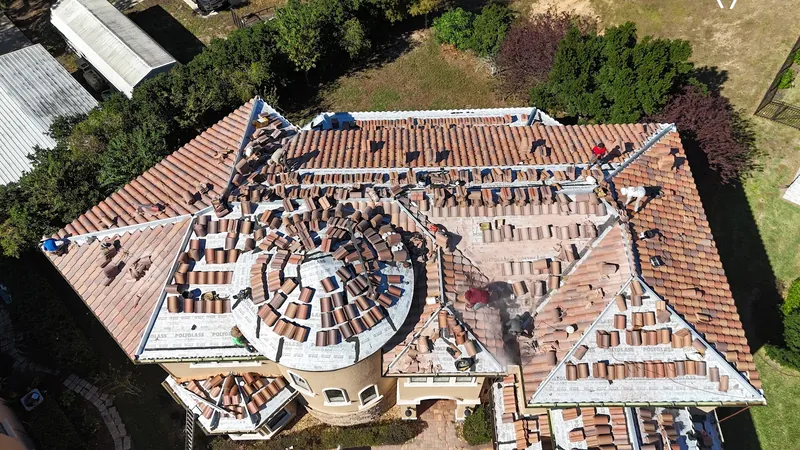
Tile is the most misunderstood roof in this market. The tile itself is close to permanent. The underlayment beneath it lasts twenty to thirty years, however good the tile looks from the street. That gap produces a roof that looks immaculate and is leaking.
Catching a tired underlayment on a scheduled visit lets you plan the work; finding it through a ceiling is a much bigger job.
Metal roofs
Standing seam metal needs very little, beyond an occasional inspection. Exposed-fastener panels need their screws checked, because the rubber washers age and the screws can back out. Near the water, look closely at trim and flashings for corrosion.
Flat roofs
Flat and low-slope roofs need the most attention. Drains and scuppers clog with leaves, and water that ponds after the heavy afternoon storms stresses seams and wears the membrane early. For commercial flat roofs we recommend two visits a year, once before the season and once after the wet season. Our flat roofing page goes into the detail.
Can you repair your own roof in Florida?
Sometimes, legally. Florida’s owner-builder exemption, section 489.103(7) of the Florida Statutes, lets property owners act as their own contractor on a one- or two-family home they live in and do not offer for sale or lease. The owner has to sign the building permit application in person and supervise the work directly, and cannot hand that supervision to someone else. Selling within a year of finishing creates a presumption the work was done to sell.
Whether you should is another question. A roof leak is mostly a diagnosis problem. Leaks start at flashings and penetrations far more often than in the middle of a slope, and the stain inside is rarely below the hole. A patch in the wrong place stops nothing, and a permit-required job done without a permit can cause trouble at insurance renewal or at sale.
As for a handyman: Florida exempts casual, minor work under $2,500 in total (s. 489.103(9)), but not when it is part of a larger job, and not for anyone who advertises as a contractor.
Repairing roofing falls within the defined scope of a licensed roofing contractor (s. 489.105). For anything beyond a small fix, check the license on the Florida DBPR site before work starts.
Sources: Florida Statutes s. 489.103 and s. 489.105 (2026 edition).
What a professional maintenance visit includes
A maintenance visit from us is a full evaluation plus light service, not a look from the driveway.
- Condition assessment. Shingles, tiles or panels, plus flashings, ridge caps, gutters, soffits and fascia.
- Preventive repairs on the spot. Loose flashings resealed, exposed fasteners treated, cracked or slipped tiles reseated, and debris cleared from valleys and gutters during the same visit.
- Growth treatment. Algae dealt with early, before it is established.
- A dated written report with photographs. It shows you have maintained the property, which is worth having at renewal and when you sell.
Maintenance has limits. When a roof is near the end of its life, regular patching costs more than it saves. Our guides to roof inspection cost and asphalt roof replacement cost help with that decision, and the insurance roof inspection guide covers what carriers look for.
Roof maintenance across Southwest Florida
We run annual and twice-yearly maintenance for homes and businesses across the five counties we cover. In the north that includes Sarasota, Bradenton, Venice and North Port. In the south it includes Fort Myers, Cape Coral, Estero and Naples.
Not sure whether you need a plan or just a look? Book the free inspection first, then decide. Our roof maintenance visits are timed around hurricane season and the wet season, and every one ends with a dated report you keep.
Roof maintenance questions
How often should a roof get maintenance in Florida?
We recommend once a year for most roofs here, and twice a year for roofs over 15 years old, homes near the water and commercial flat roofs. Spring, before hurricane season starts on June 1, is the best single time, with a second check after the wet season on older roofs.
Can a handyman fix a roof leak in Florida?
Only small jobs. Florida exempts casual, minor work under $2,500 in total (Florida Statutes s. 489.103(9)), but not work that is part of a larger job or done by someone who advertises as a contractor. Repairing roofing is within the scope of a licensed roofing contractor, and most leaks need a proper diagnosis because the stain is rarely under the hole.
How do I repair my own roof?
Florida's owner-builder exemption lets you work on a home you live in if you sign the permit application yourself and supervise the work directly. Safely, most homeowners should stick to work from the ground: gutters, branches, attic checks and binoculars. Walking a roof, especially tile, risks a fall and cracked tiles.
What's the cheapest way to fix a roof?
Catching problems while they are small. A loose flashing, a slipped tile or a clogged valley handled on a maintenance visit is a line item. The same problem found as an active leak usually brings interior damage with it. When a roof is near the end of its life, repeated patching can end up costing more than a replacement.
How urgent is roof repair?
Active water coming into the house is urgent, and a tarp stops the damage while a permitted repair is arranged. Lifted shingles, slipped tiles or damaged flashing after a storm should be looked at before the next heavy rain. Cosmetic issues, like algae streaks, can wait for a scheduled visit.
Should I pressure wash my roof?
No. The Asphalt Roofing Manufacturers Association says not to use a power washer, brush or broom on algae streaks, because scrubbing strips granules. It recommends a diluted bleach solution mixed to the shingle maker's directions, applied gently and rinsed, ideally by a professional.