
Commercial roofing in Sarasota and across Southwest Florida is a different discipline from residential work, and treating it as the same job with more square footage is where a lot of commercial projects go wrong. Flat and low-slope systems dominate the commercial stock here — retail along the main corridors, office parks, warehouse and industrial space — and they face drainage, membrane and structural load demands that a pitched residential roof never encounters.
The thing that separates a good commercial roof from a problem one in this market is drainage, not membrane brand. The region takes roughly 56 inches of rain a year, delivered mostly in intense short storms through the wet season. A flat roof that lets water pond, even briefly, degrades its membrane faster, stresses seams and flashings, and creates the conditions for biological growth and structural stress that a properly drained roof simply never sees.
The second factor is penetrations. Commercial roofs carry HVAC units, exhaust systems, drains and vents — dozens of holes a residential roof does not have. Every one is a potential leak, and the quality of the flashing detail around equipment curbs and pipe boots usually determines how the roof performs over twenty years far more than the membrane specification does.
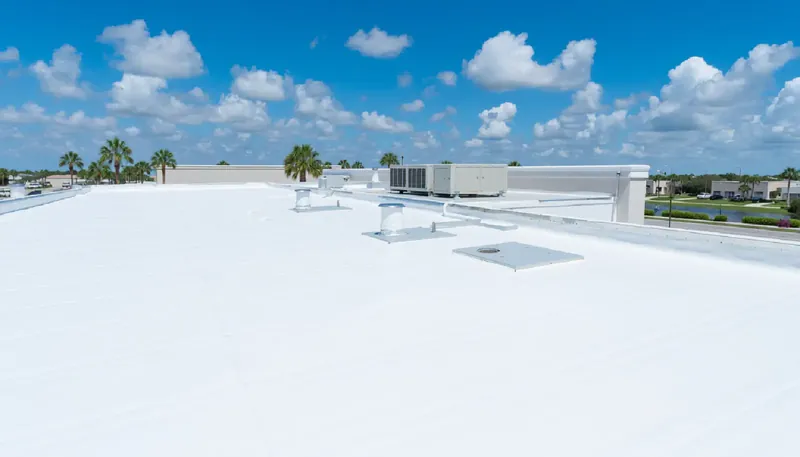
Systems We Install
TPO
Our most frequently specified commercial membrane and, for most buildings here, the sensible default. The reflective white surface cuts rooftop heat absorption and cooling load, which is worth real money in a year-round cooling climate, and the seams are heat-welded rather than adhered or taped — which produces a genuinely monolithic surface instead of a set of joints waiting to separate.
EPDM
A proven single-ply option for larger, simpler low-slope roofs with few penetrations. Excellent ozone and UV resistance and a long commercial track record. It is the right answer on a big straightforward rectangle and the wrong one on a complex roof covered in equipment.
Modified bitumen
Layered, built-up construction that earns its place on roofs with heavy foot traffic or a lot of mechanical penetrations. The multi-ply build adds physical durability where people actually walk. Torch-applied or self-adhered depending on the application, and a common choice on industrial and warehouse property.
Choosing for Your Building, Not for Our Convenience
A contractor recommending the same system for every building regardless of use is not doing the assessment. Buildings with significant rooftop plant or regular maintenance traffic want modified bitumen’s durability, or TPO with reinforced walkway pads laid into the high-traffic routes. Retail and office property chasing lower cooling costs generally does best under TPO’s reflective surface. Large simple geometries with few penetrations suit EPDM.
Geometry drives the installation approach as much as use does. A large rectangular roof allows efficient seam layout and straightforward drainage. Complex rooflines with multiple levels, parapets and equipment wells need drainage designed deliberately, because those are exactly the shapes that produce the low spots where ponding becomes chronic. On every installation we build in tapered ISO board insulation to create positive fall toward the specified drains, rather than relying on whatever slope the structure happens to have — which on a lot of commercial buildings is close to none.
Permitting and What Comes After
Commercial permits carry requirements beyond residential re-roofing, and projects above certain scope thresholds may need engineered drawings or additional plan review before anything starts. We manage the whole process: application, plan review coordination where it applies, inspection scheduling at each milestone, and the final Certificate of Completion. For a property manager running several buildings, that administrative handling is frequently worth as much as the installation.
After that, lifespan is decided by maintenance more than by installation quality. UV degradation of the membrane surface, debris building up around drains, and seam separation from thermal movement are the standard failure points here, and every one of them is dramatically cheaper to deal with on a scheduled visit than after it has put water into the building.
We run a bi-annual program for commercial flat roofs: once before hurricane season in June, once after the wet season ends. Drain clearing, seam inspection, membrane condition assessment, and a recoating recommendation where recoating would genuinely extend service life rather than merely defer the conversation. See flat roofing for the membrane detail and maintenance for how the visits work.
Why Businesses Use Us
- Licensed contractor of record. On a commercial project the permit must be pulled by the licensed contractor, not the owner. That is us, under license CCC1337243, including plan review coordination and county inspections.
- Insurance certificates upfront. General liability and workers’ compensation documentation provided before you ask, because property managers need it on file rather than on request.
- Bi-annual inspection program. Before the season and after the wet season, which is when the problems are still small enough to be line items.
- Scheduled around trading hours. Where the project allows it, work is planned around your operation and coordinated directly with whoever manages the building. Where it genuinely cannot be, we say so during planning rather than on the morning.