
Flat and low-slope roofing raises a set of problems in this climate that barely exist in drier markets. The region takes roughly 56 inches of rain a year, delivered largely in intense afternoon storms through the wet season, and a flat system that drains slowly or ponds at all will fail years ahead of its rated life.
That is why the first question on any flat roof here is not which membrane but where the water goes. We install TPO, EPDM and modified bitumen for commercial property and for residential flat sections across all five counties, and drainage is engineered into every installation rather than left to whatever fall the building happens to have.
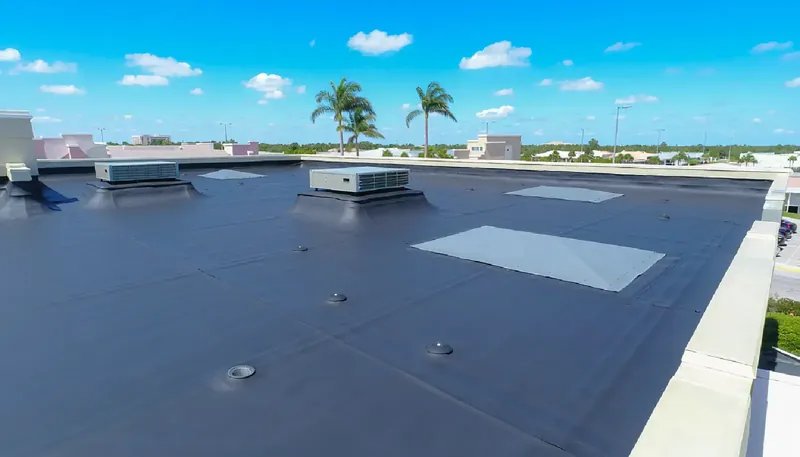
Three Membranes
TPO
The most frequently specified system, and the sensible default for most buildings here. A reflective white surface that cuts cooling load in a year-round cooling climate, heat-welded seams rather than adhered or taped ones, and strong UV stability under this much sun.
EPDM
Proven single-ply rubber, well suited to larger low-slope roofs with straightforward geometry and few penetrations. Excellent ozone and UV resistance and a long commercial track record. It is the right call on a big simple roof and the wrong one on a complicated roof covered in plant.
Modified bitumen
Layered, built-up construction that earns its keep on high-traffic rooftops and roofs with a lot of mechanical penetrations. Multi-ply build for physical durability where people actually walk. Torch-applied or self-adhered depending on the application.
Why Drainage Decides It
Standing water is the enemy of every flat roofing system, and rainfall intensity here makes drainage design at least as important as the membrane choice itself.
Water that ponds — even temporarily, even in a shallow depression nobody notices from the ground — accelerates membrane degradation, puts continuous stress on seams and flashings, and creates the conditions for biological growth. On a roof with a twenty-five year rated membrane, a persistent low spot is the thing that turns it into a fifteen year membrane.
Every flat installation we do incorporates tapered ISO board insulation to create positive fall toward the specified drain points, sized for Gulf Coast rainfall loads rather than applying a national standard to a Florida application. On many commercial buildings the existing structural slope is minimal or effectively nil, so relying on it is not a specification — it is a hope.
Maintenance Is Not Optional Here
Flat roof maintenance matters more in this climate than in most. UV degradation of the membrane surface, debris accumulating around drains, and seam separation from thermal expansion and contraction are the three standard failure points, and any one of them can put water into the building within a single wet season if nobody is looking.
We run inspection and recoating programs for commercial and residential flat roofing. Recoating, done at the right point, extends membrane life substantially and pushes a full replacement years down the road — done too late it is money spent on a roof that needed replacing anyway, which is why the timing judgment is the valuable part. Details on how the visits work are on the maintenance page, and the building-level picture is on commercial roofing.
Included on Every Flat Roof Project
- Full system installation in TPO, EPDM or modified bitumen, to 2023 Florida Building Code commercial standards.
- Engineered drainage on every job. Tapered ISO board designed for positive fall, never left to the building’s existing slope.
- Storm response. Emergency tarping and permitted repair for flat roof storm damage, with expedited county permitting after a named event.
- Maintenance and recoating options that extend membrane life and delay the cost of a full replacement.
Flat roofing is not only a commercial concern. Modern residential architecture, additions, porches and garage extensions all produce low-slope sections, and the same drainage and membrane principles apply at the smaller scale. If you have a flat section that has started staining a ceiling below it, that is a repair conversation worth having early.