
Florida’s homeowners insurance market has made the roof inspection a more consequential piece of paperwork than it used to be. Carriers writing here are scrutinizing roof age, condition and code compliance, and a number of them are non-renewing policies on roofs that have never been professionally assessed. Many will not write a new policy on a roof over fifteen years old without one, and some set that threshold at ten for shingle roofs in coastal high-wind zones.
So an inspection is no longer only about whether the roof leaks. It is increasingly the document that decides whether the roof stays insurable, and at what price. We do them free across all five counties we cover, performed by a DBPR-licensed contractor rather than a subcontracted salesperson who is paid on what he finds.
If the roof is fine, the report says the roof is fine. That is not a courtesy — a report that always finds work is a report nobody can use.
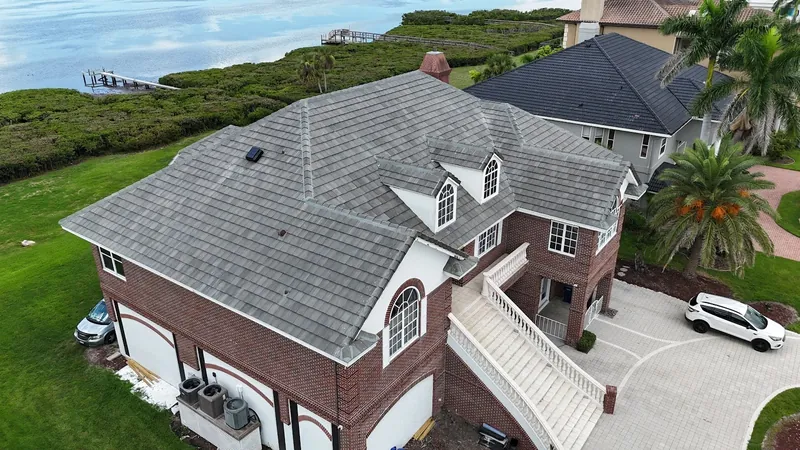
Four Different Inspections
They are not the same job, and the reason you need one changes what we look at and what the report has to prove.
Storm damage inspection
After a named storm or a significant wind event, to document wind uplift, displaced shingles or tiles, and flashing damage in a dated written report. Full photographic documentation, damage assessed specifically against that storm event, and a written report the same day where we can.
Insurance and wind mitigation guidance
Assesses the roof against what carriers are currently asking for, records age and condition for a renewal request, and identifies whether the roof likely qualifies for wind mitigation credits. To be precise about the boundary: the official Form OIR-B1-1802 is completed by a licensed wind mitigation inspector, not by us. What we do is tell you whether it is worth booking one, and refer you to somebody who can.
Pre-purchase and pre-sale inspection
A roofing-specific evaluation that goes deeper than the roof section of a general home inspection. Remaining service life, underlayment condition, flashing integrity, permit history where it is available on record. Findings written so they are usable in a negotiation or a disclosure.
Routine condition inspection
The annual or bi-annual check that catches things while they are still small. Worth doing on any roof over ten years old, and it establishes a dated baseline you can compare against later.
What We Look At
The whole system, not the surface. Shingles, tiles or panels are assessed for wind uplift, granule loss, cracking and displacement. Flashings around chimneys, skylights, vents and wall transitions are checked for sealing failure, which is among the most common sources of water intrusion in Florida homes and the one most often missed. Underlayment condition is evaluated where it is accessible, along with ridge caps, soffits, fascia and gutters.
We also compare what is up there against the 2023 Florida Building Code and flag anything that falls short. That matters most on older housing stock, where a roofing system installed before the 2002 code updates may not meet current wind resistance requirements even though it has never leaked.
When to Book One
- After any named storm. Wind damage is frequently invisible from the ground. A shingle that lifted and resettled, or a tile that shifted slightly, often becomes a leak at the next heavy rain rather than showing itself immediately.
- Before hurricane season, ideally in spring. That leaves time to complete any repair before the June-to-November window rather than trying to get a crew during it.
- As the roof approaches ten to fifteen years. The age band where carriers start looking closely. Knowing where you stand early means you plan a replacement on your schedule rather than on a non-renewal notice.
- Before you buy or sell. A general home inspection usually assesses the roof from the ground or the attic, and its remaining-life figure is an estimate. A licensed roofer actually on the roof produces something different.
What Makes These Worth Having
The inspection is genuinely free and it stays free. There is no upsell attached, and if your roof is in good condition that is what you will be told and what the written report will say.
Every inspection is carried out by a Florida DBPR-licensed contractor under license CCC1337243. The documentation is built to be used — full photo report and written findings in a form that supports a renewal, a sale or a wind mitigation submission — rather than a checklist with boxes ticked. And it is done by people who work in this market every week and know what these counties and these carriers actually ask for.