
Roof repairs on the Gulf Coast run from trivial to serious, and the difficulty is that they do not look very different from the ground. A few displaced tiles after an afternoon storm and the early stage of a failing underlayment present identically to a homeowner standing in the driveway. What separates them is somebody getting on the roof and looking properly.
Whatever the scope turns out to be, the same three things apply. The work needs doing by a licensed contractor, it needs permitting where the scope requires it, and it needs documenting thoroughly, so you have a dated record of what was wrong and what was done.
We take repair calls across Sarasota, Manatee, Charlotte, Lee and Collier counties, including the barrier islands and the inland communities along I-75. Where water is actively coming into the house we can tarp it while the permitted repair is scheduled.
The Repairs We Actually Get Called For
Storm and wind damage
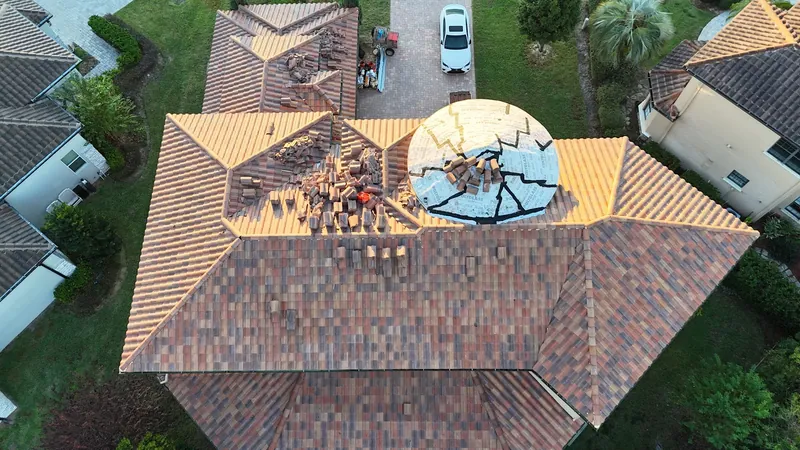
Wind-displaced shingles and tiles, torn or lifted ridge caps, damaged soffits and fascia after a named storm or a severe wind event. This is the category where documentation matters most: we photograph the damage before touching anything, so there is a dated record of what the storm did. Counties expedite storm-related permits, which shortens the wait for a permanent repair.
Leak detection and repair
The single most useful thing to know about a roof leak is that the stain on your ceiling is almost never underneath the hole. Water travels along decking and rafters, sometimes several feet, before it finds somewhere to drop. Leaks overwhelmingly start at flashings and penetrations — around chimneys, skylights, vent stacks, and where the roof meets a wall — rather than in the middle of a field of shingles. We find the entry point before we repair anything, because repairing where the water appears fixes nothing.
Flashing and ridge cap repair
Salt air corrodes metal flashing faster here than most homeowners expect, and it does it quietly. Failed seals around chimneys, skylights and vents, and lifted or torn ridge caps, are the standard findings on a roof that is otherwise sound. We reseat and reseal with corrosion-resistant materials, which is the difference between fixing it and doing it again in three years.
What Goes Wrong on Roofs Here
The climate produces a fairly predictable set of failures. After a wet season the common calls are wind-displaced shingles and tiles, lifted ridge caps, failed flashing seals around penetrations, and soffit and fascia damage from wind-driven rain. On older housing stock — the established neighborhoods, the homes west of Tamiami Trail, anything that went up before the 2002 code updates — the recurring findings are failing underlayment and corroded flashings, both of which become leaks during the next wet season if nobody addresses them.
A repair is not always the right answer, and we would rather say so at the inspection than after you have paid for three of them. If the damage is extensive, or the roof is already near the end of its service life, a full replacement is usually the cheaper decision measured across the next few years.
Permits and the Insurance File
Permitted repairs matter more in Florida than most homeowners realize. Carriers check permit records. Work performed without a permit hands them grounds to deny a related claim, and it complicates a sale later, because buyers’ inspectors and title companies routinely flag open or missing permits.
Not every repair needs one — minor work on a small percentage of the roof surface often does not — but anything significant does. We assess the requirement on every job and pull the permit where it applies. You get before-and-after photographs and a written description of what was wrong and what was done, dated, for your own records.
If the repair is storm-related, we would usually recommend a full roof inspection first rather than repairing only the visible damage. Wind damage is frequently invisible from the ground, and a repair that fixes only part of the picture tends to be followed by a second one.
Why People Call Us Back
- Storm calls go to the front. Where water is entering the house we will tarp it so the interior damage stops while the permitted repair is arranged.
- Permitted and photographed. Every repair that needs a permit gets one, and every repair gets before-and-after documentation.
- A plain written report. What we found, what we fixed and when, with photographs, so you hold a dated record of the roof.
- Honest scope. We fix what needs fixing. If a repair is not the right long-term answer we will tell you that instead of selling you one.
Roof Repair by Town
Each town has its own housing stock, wind requirements and permit office, so each has its own page on how we handle roof repair there.