
Roof repair in Estero is home turf for us. Troy Martin, who runs the southern half of Florida Gulf Roofing, is based in the village, so your repair is scoped by an owner who works these streets every week rather than a crew sent down from another market.
Much of Estero’s housing is fairly new and sits inside gated, deed-restricted communities. That changes what tends to fail. Leaks here usually trace back to tile underlayment, a seal around a vent or a wall, or a roof put on in a hurry after Hurricane Ian, more often than to a roof simply wearing out.
Each repair begins by finding where the water truly enters. When the scope calls for a permit, we file it with the Village of Estero’s Community Development Department, not with Lee County. You get before-and-after photos and a short written account of what we found and fixed.
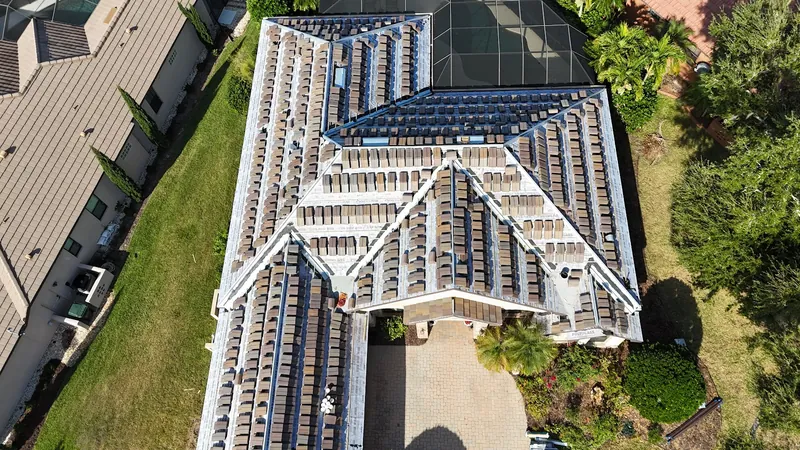
Tile Roof Repair in Deed-Restricted Communities
Tile is everywhere in Estero’s gated neighborhoods, and a leaking tile roof is seldom a tile problem. The underlayment beneath the tile is the real waterproof layer, and it wears out long before the tile does. A roof can look spotless from the street and still be letting water into the ceiling.
Where the tiles are sound, we lift them, renew the underlayment and set the same tiles back. That keeps the look your association expects and costs far less than a new roof. Our tile roofing crew handles both clay and concrete, in barrel and flat profiles.
Roof Leak Repair: Finding Where the Water Gets In
The stain on your ceiling is rarely under the hole. Water rides along the deck and rafters, sometimes for several feet, before it drips through. Patching right above the stain is how a leak gets “fixed” two or three times.
We check every penetration and transition before deciding what to repair, then reseal with corrosion-resistant materials so the work lasts.
- Vent stacks and plumbing boots with failed seals
- Step and wall flashing where the roof meets a wall
- Skylight and chimney flashing
- Ridge caps that lifted or tore in high wind
Storm Damage Roof Repair in a High Wind Zone
Lee County’s design wind speed is about 150 mph under the current Florida Building Code, one of the highest in Southwest Florida. A repair has to meet that standard too, which means the right fastening and products that carry Florida Product Approval, not whatever is on the truck.
Wind damage is often invisible from the ground. A shingle that lifted and settled is no longer sealed, and a shifted tile can start leaking at the next downpour. After a storm we photograph the roof before any work, and where water is getting inside we can tarp it while the permanent repair is permitted. A free roof inspection is the best first step after any named storm.
Post-Ian Roofs and When a Repair Is Not Enough
A large number of Lee County roofs went on in the eighteen months after Ian, often under pressure, with shortages and crews from out of state. Most of that work is fine. Some is not, and the company that did it may no longer be around to stand behind it.
We will tell you plainly which one you have. If the problem is widespread or the system is near the end of its life, a patch only buys a little time, and roof replacement in Estero is the better use of your money. Our Estero roofing page covers the Village permit process, and neighbors to the south can see roof repair in Bonita Springs.
Why Estero Homeowners Call Us for Repairs
- An owner based in the village. Troy Martin runs the southern operation from Estero, not from a distant office.
- Permits with the Village. Estero has its own Community Development Department, and we file with it directly.
- Underlayment work, not tile waste. Sound tiles go back on the roof, so the association look stays intact.
- Repairs to the local wind standard. Fastening and approved products matched to Lee County’s requirements.
- Straight answers on post-Ian roofs. If another crew’s work is fine, we say so and leave it alone.