
The residential roofing market on this coast is one of the most demanding in Florida. Gulf humidity, year-round UV, salt air off the bay and the barrier islands, and the annual certainty of hurricane season combine to shorten material lifespans and to expose a bad installation within a handful of years rather than a couple of decades.
That is the honest frame for the material conversation. A roof specification that is perfectly sound in Georgia is not automatically sound three blocks from the Gulf, and the difference is not marketing — it is corrosion rates and uplift resistance.
We install, repair and replace residential roofing across Sarasota, Manatee, Charlotte, Lee and Collier counties, permitted through whichever jurisdiction covers your address, and built to what the local climate actually asks for.
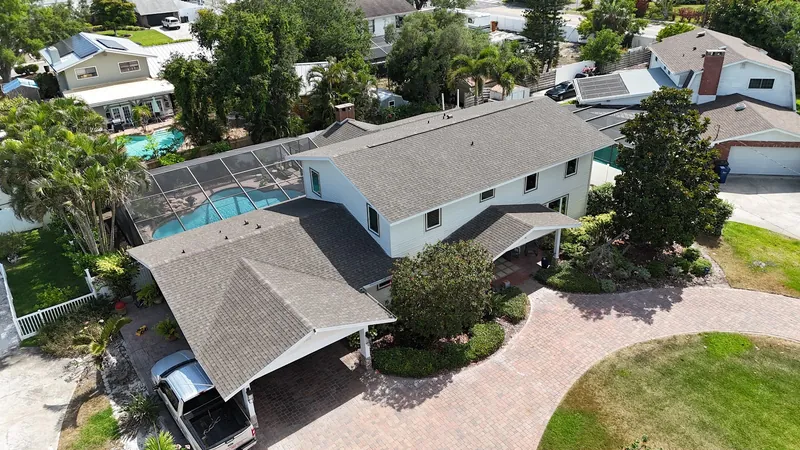
Choosing the Material
The material decides lifespan, insurance treatment and, in a lot of communities, whether the architectural review board approves it. Here is the short version of each; the detail is on the pages linked from them.
Asphalt shingle
Architectural shingles from Owens Corning, GAF, TAMKO and CertainTeed, all Florida Product Approved and wind-rated to what your county requires. Twenty to thirty years is realistic here, algae-resistant grades are worth the modest premium on a shaded or north-facing roof, and it remains the most cost-effective option by a clear margin. Shingle roofing in detail ›
Clay and concrete tile
Barrel and flat profiles, and the defining material of this region’s Mediterranean housing stock. Naturally resistant to salt air and high wind, fifty years and often considerably more — provided the underlayment beneath it is maintained, which is the part that actually fails. Heavier than anything else, so the structure gets confirmed first. Tile roofing in detail ›
Metal
Standing seam, 5-V crimp and exposed fastener. This is the category our crew has the deepest experience in, and on coastal and barrier island property it is frequently the correct answer rather than the ambitious one. Forty to seventy years and the strongest wind mitigation credits available. Metal roofing in detail ›
How the Permit Works
Every re-roof requires a permit, and it can only be pulled by a Florida DBPR-licensed contractor — not by you, and not by an unlicensed crew working under somebody else’s number. Applications go through the relevant county or city portal, standard residential permits typically process within several business days to a week, and the county then inspects at specific milestones as the work progresses. The job is not finished until a final inspection passes and a Certificate of Completion is issued.
That certificate is worth more than it looks. Unpermitted roofing can void homeowners insurance, complicate a sale, and leave you with no recourse if the work fails. We handle the whole process on every residential project as part of the job rather than as a line you can decline.
Wind Mitigation Credits
A new roof is an opportunity to cut your premium, but only if it is installed with that in mind. Florida law requires carriers to offer discounts for homes demonstrating hurricane-resistant features, verified through a wind mitigation inspection on Form OIR-B1-1802.
The features that generate the largest credits are hip roof shape, a secondary water barrier, enhanced deck fastening patterns and hurricane strap roof-to-wall connections. Together they can move a premium by ten to fifty percent or more. We build them into every applicable installation and recommend booking the wind mitigation inspection as soon as the roof passes its final county inspection — the credits do not apply themselves.
What Actually Goes Wrong Here
- Flashing failure. The most common source of leaks in homes on this coast. Salt air corrodes metal flashing around chimneys, vents and wall transitions faster than most owners expect, and it happens silently.
- Underlayment degradation under tile. The tile outlasts what is under it by decades, so a tile roof can leak while looking perfect from the street.
- Wind uplift that never showed. A shingle that lifted and resettled looks fine from the ground and is no longer sealed.
- Biological growth on shaded slopes, which holds moisture and accelerates granule loss over years rather than months.
If you are seeing any of these, a repair deals with it directly. Once a roof has reached the point where repairs stop holding, replacement is the cheaper decision.
Why Homeowners Choose Us
Florida Gulf Roofing holds a current, verifiable state contractor license — CCC1337243 — rather than a local registration limited to one jurisdiction. Permits, inspections and the Certificate of Completion are standard on every job and never presented as an add-on. There is a local office and a local number at each end of the coast, and a record of permitted work you can look up in county records.
Between the two owners there is nearly a decade of combined roofing and construction experience, built on real jobs through real Florida storm seasons. Troy has worked Florida storm seasons since 2017. Both are Florida Gulf Coast University graduates who live in the markets they run, which is the entire difference between us and a crew that arrives after a hurricane and leaves before the next one.