
Source: This Old House, how much does a new roof cost? (updated October 2026), for a 2,000-square-foot roof with builder-grade materials.
There are four residential roofing types on almost every street in Southwest Florida: asphalt shingle, clay or concrete tile, metal, and membrane roofing on flat or low-slope sections. Shingle costs the least up front, tile lasts the longest, and metal does best near salt water and earns the biggest insurance credits. Most homes end up with one of the first three, plus a flat section somewhere.
The national guides rank roofs for a national climate. This one compares the residential roofing types the way they behave here, with heat, humidity, salt air and a hurricane season every year, and with the Florida Building Code deciding what can go where.
If you already know you want two or three priced side by side, our residential roofing team will price more than one material on your own roof, so you can see the real gap rather than a rule of thumb.
In this guide
- Residential roofing types at a glance
- Asphalt shingle
- Clay and concrete tile
- Metal roofing, and its three types
- Flat and low-slope sections
- What Florida changes about the choice
- How to choose
- Residential roofing in Southwest Florida
- Residential roofing questions
Residential roofing types at a glance
The cost column is This Old House’s national average for an installed roof. The lifespan column is what we see on this coast, which can differ from a national figure, and the slope column is the minimum Florida’s residential code allows.
| Roof type | Avg. installed cost | Realistic life here | Minimum slope | Best at |
|---|---|---|---|---|
| Asphalt shingle | $5.16/sq ft | 20–30 years | 2:12 | Lowest cost, widest choice |
| Concrete tile | Less than clay | 50 years or more | Per the FRSA/TRI tile manual | Tile look at a lower price |
| Clay tile | $22.21/sq ft | 50 years or more | Per the FRSA/TRI tile manual | Longest life, Mediterranean homes |
| Metal (standing seam) | $19.30/sq ft | 40–70 years | 1/4:12 | Coastal property, wind credits |
| Flat membrane (TPO, EPDM, mod bit) | Depends on the system | 20–30 years with care | 1/4:12 design slope | Additions, porches, carports |
Sources: This Old House, new roof cost (October 2026); 2023 Florida Building Code, Residential, chapter 9; This Old House, 3 types of flat roofs (March 2026).
Asphalt shingle
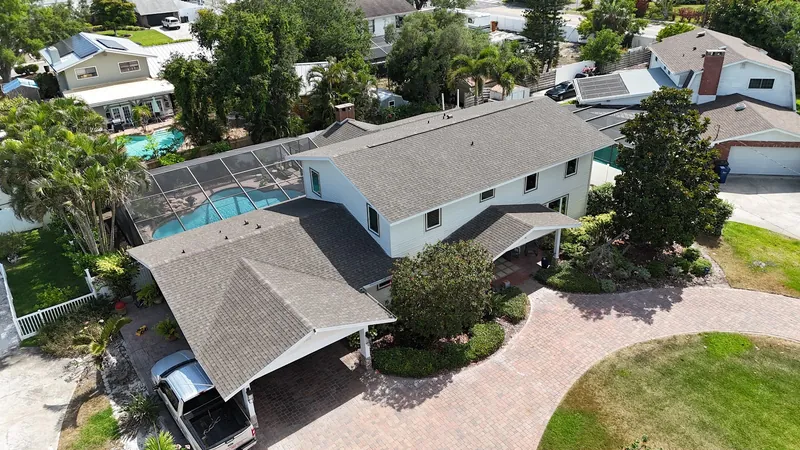
Shingle is the most common residential roof in this market and the most cost-effective by a clear margin. Today that means architectural (dimensional) shingles. The flat three-tab shingles still found on a lot of older homes here are a step below.
- Life: twenty to thirty years is realistic in this climate.
- Grades worth knowing: algae-resistant shingles are worth the modest premium on a shaded or north-facing roof, where black streaking holds moisture against the surface. Impact-resistant grades earn a discount with some carriers, so they are worth weighing against your own policy.
- Wind: the shingles we install from Owens Corning, GAF, TAMKO and CertainTeed carry Florida Product Approval and the ASTM D3161 Class F wind rating.
- Limits: Florida’s residential code allows asphalt shingles only on slopes of 2:12 or steeper.
For prices by shingle grade and a way to estimate your own roof, see our guide to asphalt roof replacement cost.
Clay and concrete tile
Tile is the defining roof of this region’s Mediterranean housing, and in many neighborhoods it is what the house was designed for and what the association expects. Both clay and concrete resist salt air, UV and high wind well. This Old House puts clay tile at 50 to 100 years and concrete at about 50.
- Clay: the premium option, with a fired color that resists fading.
- Concrete: comparable wind and weather performance at a meaningfully lower price, with a much wider range of colors and profiles.
- Barrel or flat profile: both come in either material.
The point that catches people out is underneath. The tile can last fifty years or more, but the underlayment below it, the actual waterproof layer, typically needs replacing every twenty to thirty years. A tile roof can leak while looking perfect from the street. Where the tile is still sound, it can be lifted, the underlayment replaced and the same tile reinstalled for a fraction of a full replacement.
Tile is also heavy. Clay can weigh three to four times what shingles do, so a home switching from shingle to tile needs its framing confirmed first. Florida’s residential code sends tile slope and underlayment rules to the FRSA/TRI Florida High Wind Concrete and Clay Roof Tile Installation Manual.
Sources: This Old House, the best types of roofs (updated June 2026); Florida Building Code, Residential, section R905.3.
Metal roofing, and its three types
Metal is the roofing type our crew has the most hands-on experience with. Installed correctly here, it outlasts several shingle roofs, earns the strongest wind mitigation credits available, and asks for little beyond an occasional inspection. There are three residential metal roofing types:
| Metal type | How it works | Where it fits |
|---|---|---|
| Standing seam | Panels interlock at raised seams; fasteners hidden under the joints | Most homes, especially near the water |
| 5-V crimp | A traditional Gulf Coast profile with a long history in this market | Coastal-style homes; cheaper than standing seam |
| Exposed fastener | Screws through the panel face; needs periodic fastener checks | Sheds, barns and accessory buildings |
Which metal matters as much as which profile. Near the Gulf, the bay and the barrier islands we specify aluminum, because aluminum does not rust. Galvalume-coated steel performs well inland but corrodes faster close to salt water. If a metal quote does not say which metal it is, ask before you compare prices.
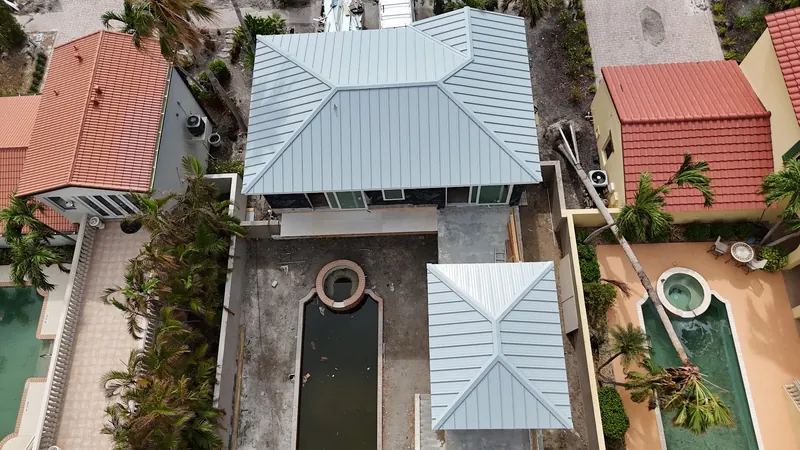
Florida’s residential code allows standing seam systems down to a slope of one-quarter inch per foot, while lapped panels without sealant need 3:12 or steeper. This Old House also notes that a metal roof can stay 50 to 60 degrees cooler than other materials in peak summer months, which counts for something in a year-round cooling climate.
Flat and low-slope sections
Few houses here have an entirely flat roof, but plenty have a flat section: an addition, a porch, a lanai roof, a garage extension or a carport. Shingles cannot go there. Those sections take a membrane: TPO, EPDM or modified bitumen.
The code sets the rule that matters. Florida’s residential code requires built-up, modified bitumen and single-ply membrane roofs to have a design slope of at least one-quarter inch per foot so water drains. In a region that takes heavy afternoon storms through the wet season, a section that ponds will fail years ahead of its rated life.
This Old House puts modified bitumen and built-up roofs at 20 to 30 years with care. Our guide to commercial roofing types compares the same membranes in more depth.
What Florida changes about the choice
- Wind. Every covering has to meet the wind rating your county requires, and the products we install carry Florida Product Approval. A roof specified well for Georgia is not automatically right three blocks from the Gulf.
- Insurance. Florida law requires insurers to offer discounts for wind-resistant features, verified on a wind mitigation inspection. A new roof installed with that in mind (secondary water barrier, deck fastening, roof-to-wall connections) can earn credits on any material, and metal scores particularly well.
- Salt air. Salt corrodes metal flashing, fasteners and steel panels faster than inland. It is the reason aluminum wins on the coast.
- Associations. HOA architectural review covers a great deal of Lakewood Ranch, Osprey, Venice and Naples, and the board may decide the material before you do.
- Permits. Every re-roof needs a permit and county inspections, whatever the material.
Source: Florida Statutes s. 627.0629, wind loss mitigation discounts.
How to choose
- Start with how long you will stay. Selling in five years favors shingle. Staying twenty favors metal or tile, which cost more on day one and less across the life of the house.
- Check the distance to salt water. On canal-front, bay-front and barrier island homes, aluminum standing seam is often the correct answer rather than the ambitious one.
- Check what the structure can carry. Switching to tile needs a structural check first.
- Read the HOA rules before you fall for a color.
- Price the insurance side. Ask your agent what a wind mitigation inspection would be worth on each option.
- Plan the upkeep. Every type needs some. Our roof maintenance in Florida guide covers what each one asks for.
Residential roofing in Southwest Florida
We install, repair and replace shingle, tile, metal and flat roofing across Sarasota, Manatee, Charlotte, Lee and Collier counties, from Bradenton and Sarasota to Fort Myers and Cape Coral. Every job is permitted and inspected, and the Certificate of Completion is part of the job.
Weighing two materials? Ask our residential roofing team to price both on your own roof. The roof inspection that starts it is free.
Residential roofing questions
What are the main types of residential roofing?
Four cover nearly every home in Southwest Florida: asphalt shingle, clay or concrete tile, metal (standing seam, 5-V crimp or exposed fastener panels), and membrane systems on flat or low-slope sections such as additions, porches and carports.
What is the best type of roof for a house in Florida?
There is no single best one. Shingle is the most cost-effective, tile lasts longest if the underlayment beneath it is maintained, and metal offers the strongest wind mitigation credits and the longest life near salt water when it is aluminum. The right choice depends on your budget, how long you plan to stay, your HOA and how close you are to the water.
What is the best residential metal roofing?
For most homes, standing seam: the fasteners sit hidden under raised seams, so nothing pierces the panel face. On coastal and barrier island property we specify aluminum rather than steel, because aluminum does not rust in salt air.
Which roofing type lasts the longest?
Tile and metal. This Old House puts clay tile at 50 to 100 years and concrete at about 50, and we see forty to seventy years from metal here. The catch with tile is the underlayment under it, which typically needs replacing every twenty to thirty years.
Can I put a tile roof on a house that had shingles?
Sometimes. Tile is far heavier than shingle, so the roof framing has to be confirmed first. We include that structural assessment on every tile project, and if the framing will not carry it, we say so and price metal or shingle instead.
Can a flat roof be used on a house?
Yes, on sections that are designed for it. Florida's residential code requires membrane roofs such as modified bitumen, TPO and EPDM to have a design slope of at least one-quarter inch per foot so water drains, and shingles may only go on slopes of 2:12 or steeper.