
Membrane families as grouped by manufacturer Johns Manville; the default and drainage notes are our own experience on Southwest Florida buildings.
Commercial roofing types fall into a few families: single-ply membranes (TPO, PVC and EPDM), bituminous systems (built-up roofing and modified bitumen), liquid coatings, and metal panels. Most commercial buildings in Southwest Florida have flat or low-slope roofs, so the choice is usually between membranes, and the right one depends on how the building is used.
This guide compares each type in plain terms, explains what Florida’s rain, heat and wind change about the decision, and lists the questions worth asking before you sign.
If you manage a building and want a straight assessment, our commercial roofing team installs TPO, EPDM and modified bitumen across the five counties we cover.
In this guide
- Commercial roofing types compared
- Single-ply membranes: TPO, PVC and EPDM
- Built-up roofing and modified bitumen
- Metal roofing on commercial buildings
- Roof coatings
- Commercial vs. residential roofing
- What Florida changes about the choice
- How to choose for your building
- Commercial roofing in Southwest Florida
- Commercial roofing questions
Commercial roofing types compared
Here is the short version. Each type is covered in more detail below.
| Type | What it is | Best suited to | Watch for |
|---|---|---|---|
| TPO | Reinforced single-ply thermoplastic sheet, seams heat-welded | Most low-slope buildings; offices and retail chasing lower cooling costs | Detailing around equipment and drains |
| PVC | Heat-weldable single-ply thermoplastic | Roofs exposed to oils, fuels or chemicals | Detailing around equipment and drains, as with any membrane |
| EPDM | Single-ply synthetic rubber | Large, simple roofs with few penetrations | Complex roofs covered in equipment |
| Modified bitumen | Layered asphalt sheets, torch-applied or self-adhered | Heavy foot traffic, many mechanical penetrations | Heat absorption unless it has a reflective surface |
| Built-up (BUR) | Alternating layers of bitumen and reinforcing felts | Buildings that value redundant layers | A dark surface unless it carries reflective granules |
| Metal panels | Standing seam, 5-V crimp or exposed fastener | Sloped commercial, agricultural and accessory buildings | Steel near salt water; fastener upkeep |
| Coatings | Liquid applied over a sound existing roof | Extending a membrane that still has life in it | Applied too late, it delays a replacement rather than avoiding one |
Single-ply membranes: TPO, PVC and EPDM
Single-ply roofs are one layer of factory-made membrane laid over insulation and fastened, adhered or, on some systems, ballasted. Johns Manville describes the group’s strengths as reflectivity, light weight and durability.
TPO
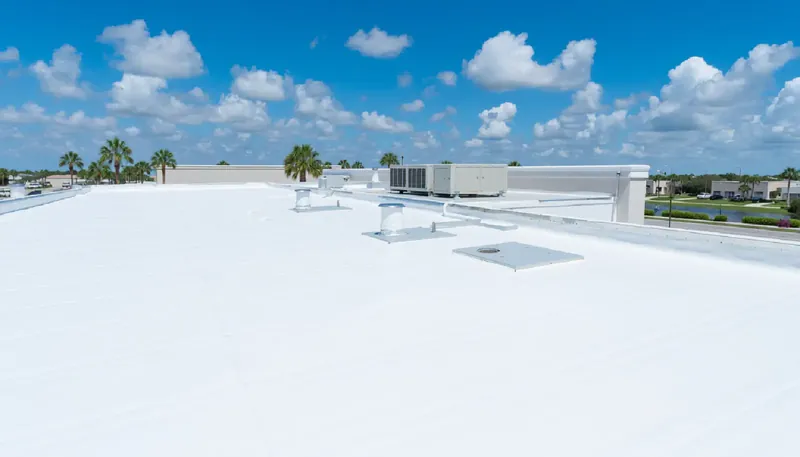
TPO (thermoplastic polyolefin) is our most frequently specified commercial membrane and, for most buildings here, the sensible default. The white surface reflects sun and cuts the cooling load, which matters in a year-round cooling climate. The seams are heat-welded rather than taped or glued, so the finished roof is one continuous surface instead of a set of joints waiting to separate.
PVC
PVC is another heat-weldable thermoplastic. Johns Manville highlights its resistance to harsh chemicals and industrial pollutants, and some of its PVC membranes are made to resist oils and fuels. That is why PVC is often considered for roofs near exhaust fans or where chemicals land on the surface.
EPDM
EPDM is a single-ply synthetic rubber with excellent ozone and UV resistance and a long commercial track record. It is the right answer on a big, straightforward rectangle and the wrong one on a complicated roof covered in equipment, where every curb is another seam to detail.
Built-up roofing and modified bitumen
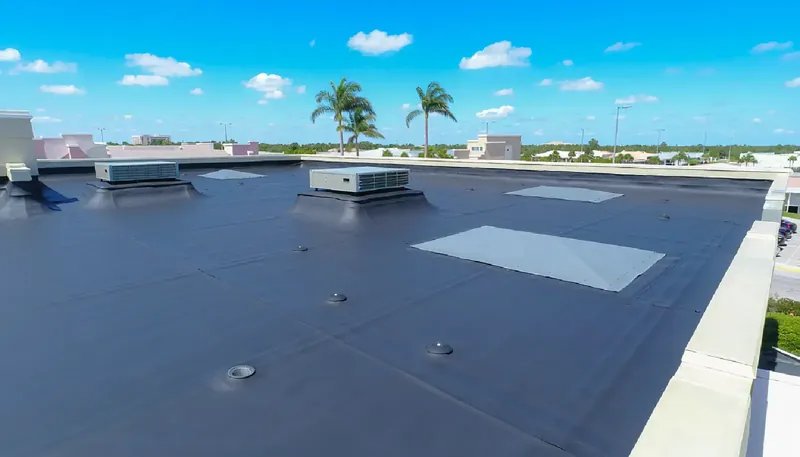
Bituminous roofs are the multi-ply family. Johns Manville, which says it pioneered built-up roofing in America more than 160 years ago, describes it as field-fabricated with layers of bitumen alternating with plies of reinforcing felts, and says the redundant layers give the roof strong resistance to water and weather. It also makes bright white granules for a more reflective surface.
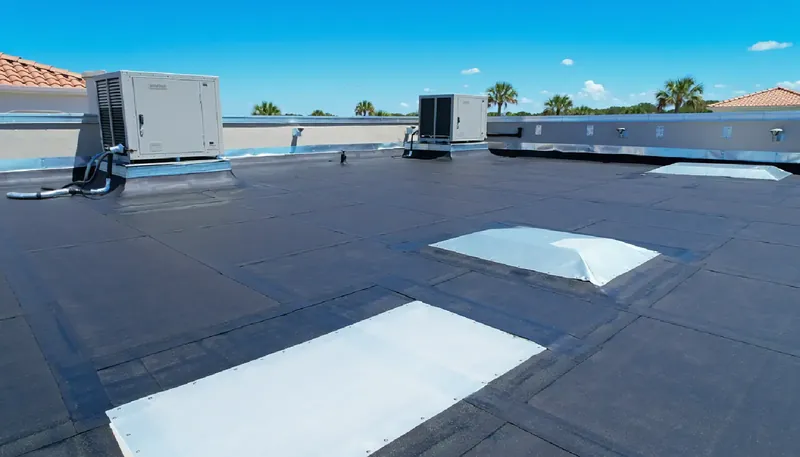
Modified bitumen takes the same layered idea and uses polymer-modified asphalt sheets (Johns Manville lists SBS and APP systems), built up in layers. It earns its place on roofs with heavy foot traffic or lots of mechanical penetrations, because the multi-ply build adds physical durability where people actually walk. It goes down torch-applied or self-adhered, depending on the building, and is a common choice on industrial and warehouse property.
Metal roofing on commercial buildings
Metal is a steep-slope option rather than a flat-roof membrane, and it is common on commercial and accessory buildings with a pitched roof. Exposed-fastener panels are the most cost-effective entry into metal and suit agricultural, commercial and accessory structures. Standing seam hides its fasteners under the seams, which removes the most common metal failure: screws leaking as their washers age.
Near the coast, the metal matters as much as the profile. We specify aluminum rather than steel for coastal and barrier island work, because aluminum does not rust in salt air. Our metal roofing page goes into the three systems.
Roof coatings
A coating is a liquid layer applied over an existing roof that is still sound. Timed right, recoating extends membrane life and pushes a full replacement years down the road. Timed too late, it is money spent on a roof that needed replacing anyway, which is why the timing judgment is the valuable part.
Under Florida law, roofing contractors cover all kinds of roofing, waterproofing and coating, except a coating that is not represented to protect, repair, waterproof, stop leaks or extend the roof’s life (Florida Statutes s. 489.105). In practice, a coating sold to stop leaks or extend the roof is roofing work, and it should come from a licensed roofing contractor.
Source: Florida Statutes s. 489.105 (2026 edition).
Commercial vs. residential roofing
The difference between commercial and residential roofing is mostly the shape of the roof and what sits on it. Homes here are mostly pitched roofs in shingle, tile or metal, where water runs off on its own. Commercial buildings are mostly flat or low-slope, where water has to be led to drains, and the roof carries HVAC units, exhausts, drains and vents: dozens of holes a house roof does not have.
That changes the job. On a commercial roof, the flashing detail around equipment curbs and pipe boots usually decides how the roof performs far more than the membrane specification does. Permits are different too: commercial permits carry requirements beyond residential re-roofing, and larger projects may need engineered drawings or extra plan review before work starts.
Many homes have flat sections as well, such as additions, porches and garage extensions. Those use the same membranes and the same drainage rules at a smaller scale; see flat roofing.
What Florida changes about the choice
Rain and drainage
The region takes roughly 56 inches of rain a year, mostly in short, intense storms through the wet season. A flat roof that lets water pond, even briefly, wears its membrane faster and stresses its seams and flashings. That is why we build tapered ISO board insulation into every flat installation, to give positive fall toward the drains rather than relying on whatever slope the structure happens to have.
Sun and heat
The EPA says a high solar reflectance is the most important property of a cool roof, and that low-slope cool roofs include single-ply membranes, light-colored coatings and reflective-granule asphalt membranes. It also notes that low-slope cool roofs need periodic cleaning to keep their reflectance. The Cool Roof Rating Council rates products for solar reflectance and thermal emittance on a scale of 0 to 1, including aged values after three years outdoors, so ask for the rated figures when you compare membranes.
Sources: EPA, using cool roofs to reduce heat islands (updated June 18, 2026); Cool Roof Rating Council, what is a cool roof.
Wind and hurricane season
We install flat roofing systems to 2023 Florida Building Code commercial standards, and a roof that went on decades ago may not meet today’s wind requirements even if it has never leaked.
How to choose for your building
A contractor who recommends the same system for every building is not doing the assessment. These are the questions that should drive it:
- How is the roof used? Regular service traffic and lots of rooftop equipment favor modified bitumen, or TPO with walkway pads along the busy routes.
- What are you paying to cool? Retail and office property usually does best under a reflective TPO surface.
- How simple is the roof? A large rectangle with few penetrations suits EPDM. Multiple levels, parapets and equipment wells need drainage designed deliberately.
- Where does the water go? Ask how the quote handles slope to drains. If the answer is the existing structure, ask again.
- Is a coating an option? Only if the existing roof is still sound. An honest contractor will tell you when it is not.
- Who maintains it? Lifespan is decided by maintenance more than installation. Plan on twice-yearly visits, once before hurricane season and once after the wet season.
For how a maintenance plan works, see our roof maintenance guide.
Commercial roofing in Southwest Florida
We work on commercial property across the five counties we cover, from Sarasota and Bradenton in the north to Fort Myers, Estero and Naples in the south. We handle the permit, plan review coordination where it applies, inspections at each milestone and the final paperwork, and we provide general liability and workers’ compensation certificates up front.
Tell us the building type and roughly the square footage, and we will come and assess it. Property managers are welcome. Start on our commercial roofing page.
Commercial roofing questions
What are the main types of commercial roofing?
The main commercial roofing types are single-ply membranes (TPO, PVC and EPDM), bituminous systems (built-up roofing and modified bitumen), liquid coatings over an existing roof, and metal panels on sloped buildings. Most commercial roofs in Southwest Florida are flat or low-slope, so the choice is usually between the membranes.
What is the difference between commercial and residential roofing?
Mostly the roof's shape and what sits on it. Homes are mostly pitched roofs that shed water on their own. Commercial roofs are mostly flat or low-slope, need water led to drains, and carry HVAC units, exhausts and vents that each need flashing. Commercial permits can also need engineered drawings or extra plan review.
Is TPO or EPDM better for a commercial roof?
It depends on the building. TPO has a reflective white surface and heat-welded seams, which suits most buildings in a cooling climate. EPDM is proven rubber that works best on large, simple roofs with few penetrations, and less well on a complicated roof covered in equipment.
Which commercial roof handles foot traffic best?
Modified bitumen's multi-ply build stands up best where people walk regularly, such as around rooftop equipment that gets serviced often. TPO with reinforced walkway pads laid along the busy routes is the other common answer.
Can a coating replace a new commercial roof?
Only if the existing roof is still sound. A coating applied at the right time can extend a membrane's life and push a replacement back by years. In Florida, a coating sold to stop leaks or extend a roof's life is roofing contractor work under s. 489.105.
How often should a commercial flat roof be maintained?
We recommend twice a year in Southwest Florida: once before hurricane season in June and once after the wet season ends. The visit covers drain clearing, seam checks and the membrane's condition, which is when problems are still small enough to be line items.