
Sources: Florida Building Commission; 2023 Florida Building Code, Residential, chapter 9.
International Residential Code roofing rules are the national model for how a house roof is built: minimum slopes, underlayment, flashing, wind ratings and when an old roof has to come off. Florida does not enforce the IRC as written. It adopts it, with its own amendments, as the Florida Building Code, Residential, and that is the code your county inspector holds a roof to.
Most of the roofing chapter reads the same in both. The Florida changes are where a roof here differs from a roof in Ohio: stronger underlayment rules for wind, wind-tested shingles, a secondary water barrier on re-roofs and a 25% rule for partial repairs. This guide walks through the parts a homeowner is most likely to meet.
Getting quotes for a new roof? Our roof replacement page explains how we handle the permit, the inspections and the close-out on every job.
In this guide
- The IRC, and which code applies in Florida
- The roofing chapter, section by section
- Underlayment: the Florida difference
- Re-roofing: when the old roof has to come off
- The 25% rule, in plain words
- Permits and inspections
- What to ask a roofer about code
- Code-compliant roofing in Southwest Florida
- Roofing code questions
The IRC, and which code applies in Florida
The International Residential Code is a model code published by the International Code Council for one- and two-family homes and townhouses. States and cities adopt it, usually with changes. Florida writes its changes into a single statewide code, the Florida Building Code, which it updates in new editions.
The edition in force is the 8th Edition (2023), which took effect on December 31, 2023, according to the Florida Building Commission. Its residential volume adopts the 2021 IRC with Florida amendments. So when someone says a roof “meets IRC,” the useful question in Florida is whether it meets the Florida Building Code, Residential.
The code also has teeth. Under section 553.79 of the Florida Statutes it is unlawful to construct, alter, modify, repair or demolish a building without first getting a permit from the local enforcing agency.
Sources: Florida Building Commission; Florida Statutes s. 553.79 (2026 edition).
The roofing chapter, section by section
Chapter 9 of the residential code, “Roof Assemblies,” carries the same section numbers as the IRC. These are the sections that shape a typical Southwest Florida roof:
| Section | What it covers | The rule in Florida |
|---|---|---|
| R903.2 | Flashing | Required at wall and roof intersections, changes in slope or direction, and around roof openings |
| R903.4 | Drainage | Roof drains at each low point unless the roof drains over its edges; overflow scuppers 2 to 4 inches above the roof where no other overflow exists |
| R905.1.1 | Underlayment | One of three high-wind methods on slopes of 2:12 and up (next section) |
| R905.2.2 | Asphalt shingle slope | 2:12 or steeper only |
| R905.2.6.1 | Shingle wind resistance | Shingles tested and classified to ASTM D3161, TAS 107 or ASTM D7158 for the site’s wind speed |
| R905.3 | Clay and concrete tile | Slope and underlayment per the FRSA/TRI Florida High Wind tile installation manual |
| R905.10.2 | Metal panels | Standing seam down to 1/4:12; lapped panels 3:12 without sealant |
| R905.9–R905.13 | Built-up, modified bitumen, single-ply | Design slope of at least 1/4 inch per foot for drainage |
| R908 | Re-roofing | Tear-off conditions, reuse of tile, the 25% rule and wind mitigation on re-roofs |
Flashing failure deserves a word of its own. Salt air corrodes metal flashing around chimneys, vents and wall transitions faster than most owners expect, and flashing failure is the most common source of leaks in homes on this coast. The code requires the flashing; good work makes it last.
The slope limits are also why some materials only suit some roofs. Our guide to residential roofing types compares them side by side.
Underlayment: the Florida difference
On shingle and metal roofs, Florida’s code asks for more than a single layer of felt. Section R905.1.1.1 gives three ways to meet it:
- Peel-and-stick over the whole deck. A self-adhering polymer-modified bitumen underlayment (ASTM D1970) across the entire roof deck.
- Taped seams, then underlayment. A strip at least 3¾ inches wide of self-adhering membrane or flashing tape over every joint in the roof deck, with an approved underlayment over the whole roof on top.
- Two layers of felt or synthetic, laid in a specific half-sheet overlap pattern starting at the eaves.
Each one aims at the same failure: water getting in through the deck joints after the wind has taken shingles off. It is also why a secondary water barrier shows up on the wind mitigation form, which can lower your premium. Our insurance roof inspection guide explains how carriers look at it.
Re-roofing: when the old roof has to come off
Section R908.3 lists when new roofing may not go on until every existing layer is removed:
- The existing roof is water-soaked, or too deteriorated to be a base for new roofing.
- The existing covering is wood shingle or shake, slate, clay, cement or asbestos-cement tile.
- The roof already has two or more layers of any covering.
- There are blisters that have not been cut or scraped open and secured.
- The new roof cannot be fastened to code through the existing one.
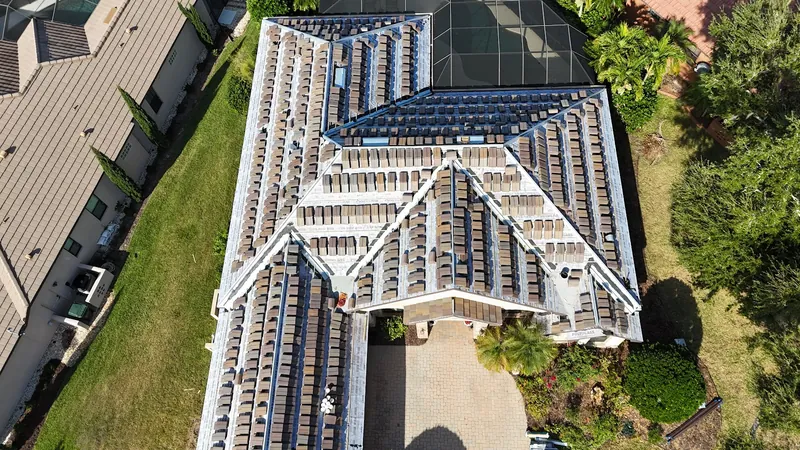
Two related rules help tile owners. Sound clay or concrete tile may be reinstalled to repair a tile roof, but cracked or broken tile may not (R908.5). And when the roof covering comes off an older home with a wood deck, one first permitted before the Florida Building Code, section R908.7 lets the roofing contractor renail the deck and add a secondary water barrier, the two upgrades that matter most in a hurricane.
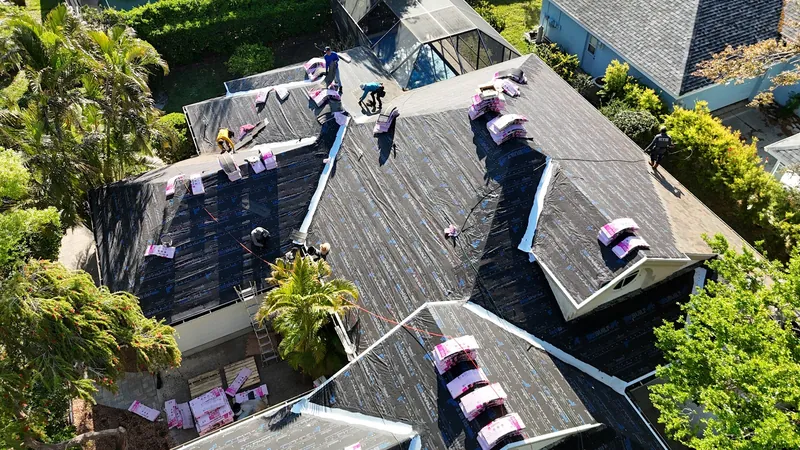
That is the code side of why our replacements are full tear-offs: anything soft or water-damaged in the deck gets found and repaired while the roof is open.
The 25% rule, in plain words
Section R908.1.1 says no more than 25 percent of a roof or roof section may be repaired, replaced or recovered in any 12-month period unless the whole roof or section is brought up to the current code.
The Legislature added an exception, now in section 553.844(5) of the Florida Statutes and in the code. If the existing roof was built, repaired or replaced to the 2007 Florida Building Code or any later edition, and 25 percent or more of it is being worked on, only that part has to meet the current code. Local governments may not amend the exception.
| Your roof | Damage to fix | What the code asks |
|---|---|---|
| Any age | Under 25% in 12 months | Repair the damaged part |
| Built or replaced to the 2007 code or later | 25% or more | Only the repaired part has to meet current code |
| Older roof, never brought up to the 2007 code | More than 25% in 12 months | The whole roof or section to current code |
In practice this decides a lot of storm claims. Where your house sits depends on when the roof was built or last replaced and on its permit record, and we work that out during the free inspection, so you know your position before you speak to your carrier rather than after.
Sources: Florida Statutes s. 553.844 (2026 edition); Florida Building Code, Residential, R908.1.1.
Permits and inspections
Every re-roof needs a permit. Applications go through the county or city portal for your address, standard residential permits typically process within several business days to a week, and the county inspects at set stages as the work goes on. The job is finished when a final inspection passes and a Certificate of Completion is issued.
That certificate matters later. Unpermitted roofing can void homeowners insurance for storm damage, complicate a sale and draw fines from the county. Bringing it into compliance after the fact is almost always slower and costlier than permitting it the first time. Florida does let owners pull a permit to work on a home they live in, if they supervise the work themselves; our roof maintenance guide covers what that involves.
What to ask a roofer about code
- Who pulls the permit, and under which license? You can check a Florida contractor’s license on the DBPR site.
- Which underlayment method is in the quote? If the answer is not one of the three above, ask again.
- What wind rating do the shingles carry, and do the products have Florida Product Approval?
- Is it a full tear-off, and how is deck damage handled if they find it?
- Will the deck be renailed and a secondary water barrier installed, and will that be documented for a wind mitigation inspection?
Code-compliant roofing in Southwest Florida
We are a Florida DBPR-licensed contractor (CCC1337243), and we pull permits through whichever jurisdiction covers your address, from Bradenton, Sarasota and Venice to Port Charlotte, Estero and Bonita Springs. Permits, inspections and the Certificate of Completion are standard on every job, never an add-on.
Planning a new roof, or not sure where you stand on the 25% rule? Start with a free inspection, then see how our roof replacement process works.
Roofing code questions
Does Florida use the International Residential Code for roofing?
Not directly. Florida adopts the International Residential Code with its own amendments as the Florida Building Code, Residential. The current 8th Edition (2023) took effect on December 31, 2023 and is based on the 2021 IRC. Roofing is chapter 9 of that code.
What is the 25% roof rule in Florida?
Section R908.1.1 of the Florida Building Code, Residential says that no more than 25 percent of a roof or roof section may be repaired, replaced or recovered in any 12-month period unless the whole roof or section is brought up to the current code. There is an exception: if the existing roof was built, repaired or replaced under the 2007 Florida Building Code or later, only the part being worked on has to meet current code.
Is there a 15-year roof rule in Florida?
That is an insurance law, not a building code rule. Section 627.7011(5) of the Florida Statutes says an insurer may not refuse to issue or renew a homeowners policy solely because a roof is under 15 years old, and for older roofs it must allow an inspection first. Our insurance roof inspection guide explains it.
Do I need a permit to replace my roof in Florida?
Yes. Florida law makes it unlawful to repair or alter a building without first getting a permit from the local building department, and the county inspects the work at set stages before it is closed out. Every re-roof we do is permitted and inspected.
Can you put a new roof over an old one in Florida?
Often not. The residential code requires the old roofing to come off when it is water-soaked or too deteriorated to be a base, when it is tile, slate, wood shake or asbestos-cement, when there are already two or more layers, or when the new roof cannot be fastened properly through it.
What is the minimum slope for a shingle roof?
Florida's residential code allows asphalt shingles only on slopes of 2:12 or steeper. Flatter sections need a membrane roof such as modified bitumen, TPO or EPDM, designed with at least a quarter inch of fall per foot.